Public-source technical review and proposed evaluation plan. No original standing, walking or recovery experiment is reported.
Abstract
Humanoid balance studies depend on both a controller and a model of the body it controls. A robot-description file can be syntactically valid while containing inconsistent mass properties, and a reduced balance model can omit constraints that determine whether a complete robot can execute a motion. This article reviews physically consistent inertial modeling, center-of-mass dynamics, the linear inverted-pendulum model and capture-point reasoning. It then proposes an evaluation plan that separates model checks, analytical verification, simulation studies and physical validation. The plan emphasizes declared assumptions, parameter uncertainty, controlled perturbations and complete outcome reporting. It contains no original performance results and makes no claim that a robot has stood, walked or recovered from a disturbance. Its intended contribution is a transparent way to formulate and report future balance experiments using public sources and reproducible model definitions.
Index Terms: Humanoid robots, balance control, inertial parameters, reduced-order models, simulation validation.
I. Introduction
A balance demonstration answers a question only when its conditions are known. Terrain, contact model, initial posture, actuator limits, state estimates and disturbances can all change the interpretation. The term “stable” should therefore be tied to a declared model and task rather than used as a general property of a robot.
This review separates two layers. The first concerns whether a body model is internally coherent and physically interpretable. The second concerns whether a controller achieves a defined balance objective under that model and, eventually, under independently measured conditions. The proposed workflow is intended for future experiments; it contains no new experimental results.
II. Public Literature and Review Boundaries
Wensing, Kim and Slotine show that physical consistency of rigid-body inertial parameters can be expressed through matrix inequalities. Their result goes beyond requiring a positive mass or a positive-definite inertia matrix alone. It offers a mathematical basis for rejecting impossible mass distributions during identification. This review does not reproduce their identification experiments. [1]
Tedrake's public robotics notes explain how center-of-pressure and center-of-mass relations produce useful reduced balance models. They also distinguish these reductions from the joint and actuator constraints needed for whole-body motion. [2]
Pratt, Carff, Drakunov and Goswami introduced capture-point and capture-region reasoning for push recovery, including an extension of the inverted-pendulum model with angular momentum. Their conference paper motivates asking when foot placement is needed to stop a motion. Its reported results belong to that work, not to this review. [3]
ToddlerBot provides a public example of a platform paper connecting calibration, motor identification, modeling and experiments. Its methodology is relevant to how a reproducible embodiment is described; no capability or numerical result is transferred here. [4]
III. Mathematical Preliminaries
A. Mass Properties and Physical Consistency
For links of mass with centers of mass expressed in a common frame, total mass and center of mass are
Each inertia tensor must state its reference point and frame. For a rotational inertia tensor about a body's center of mass, define
The mass-distribution interpretation in [1] relates physical consistency to positive mass and a positive-semidefinite , with stricter conditions for a nondegenerate three-dimensional distribution. Equivalently, the principal moments must satisfy the appropriate triangle inequalities. This is a realizability check, not a measurement of the actual hardware or proof that the parameters are identifiable from a chosen experiment. [1]
B. Reduced Balance Model
Under a constant center-of-mass height above a horizontal support plane and negligible change of centroidal angular momentum, the sagittal linear inverted-pendulum relation is
Here x is horizontal center-of-mass position, p the center of pressure, and g gravitational acceleration. With nonnegative normal contact forces on coplanar supports, the center of pressure lies within their convex hull. Equation (3) is a reduced model; it omits whole-body feasibility constraints. [2]
C. Capture-Point Reasoning
For Eq. (3), define
Direct differentiation gives
Thus, within this ideal model, choosing a fixed p equal to the initial ξ cancels the divergent component and allows the center of mass to approach that location. This familiar capture-point interpretation connects position and velocity; it is more informative than checking position alone. Practical feasibility still depends on reachable contacts, timing, friction and actuation. The algebra above is a derivation from Eq. (3), while the broader capture-region concept is developed in [3].
IV. Proposed Validation Workflow
This section proposes an evaluation plan. It is not a report of tests already completed or a reproduction of a cited platform's test suite.
A. Establish a Model Contract
A public model package should define units, frames, joint types, motion limits, collision geometry, actuator models and inertial parameters. The model file, its generator and any summary table should describe the same configuration. Alternative configurations should receive explicit names rather than silently changing a default.
The proposed checks include positive masses, consistent inertia frames, valid joint axes, connectivity, permitted configurations and agreement between independent mass summaries. Where the package includes loop mechanisms or transmission ratios, those relationships should be expressed explicitly. A visual resemblance to the intended mechanism is insufficient to determine its motion or torque mapping.
No generic size or mass threshold is prescribed here. The test should assess the published model's own declared assumptions and intended experiment.
B. Verify the Reduced Model Analytically
For constant p, Eq. (3) has the closed-form solution
Substitution verifies the differential equation and initial conditions. A numerical integrator can be compared with this analytic reference over a declared finite horizon. The proposed test reports errors in both x and velocity as the time step changes. This checks integration of the idealized equation; it does not validate a full humanoid model.
An additional symbolic check substitutes Eq. (4) into Eq. (5). These analytical relationships are proposed reference tests, not new mechanics results or completed benchmarks.
C. Define Balance Outcomes Before Running Trials
| Proposed study | Inputs to declare | Outcomes to report |
|---|---|---|
| Nominal standing | Posture, support, observation model and horizon | Drift, tracking error, contact loss and saturation |
| Disturbance response | Force location, direction, duration and waveform | Recovery, stepping, fall or other predefined terminal outcome |
| Parameter sensitivity | Mass distribution, friction, compliance and actuator uncertainty | Outcome distribution and changes in required effort |
| Timing sensitivity | Sensor delay, command delay and update schedule | Response degradation and failures |
| Contact transition | Initial support, intended next contact and terrain | Contact timing, slip and attainable motion |
The proposed disturbance specification includes impulse,
but does not reduce the experiment to that number. Equal impulses with different duration, direction or application point can induce different whole-body responses. Reports should retain the complete disturbance definition and the state when it was applied.
D. Separate Model Error From Controller Performance
The proposed study first holds controller parameters fixed while varying one modeling assumption at a time. If retuning is allowed, it reports a second comparison with the tuning procedure stated. This distinguishes robustness of the original controller from the performance of a redesigned controller.
A higher-fidelity simulation is an additional model comparison, not automatically ground truth. The workflow reserves physical validation for comparison with independent measurements and their uncertainty. NASA's public verification-and-validation terminology helps maintain that distinction; its CFD-specific procedures are not presented as a humanoid standard. [5]
V. Results to Be Reported by a Future Study
No original standing, walking or recovery results are available in this review. A future evaluation should publish the full trial count, initialization procedure, simulation horizon, random seeds when applicable and the disposition of every run. Crashes and incomplete runs should remain visible rather than disappearing from success-rate denominators.
Suggested outputs include center-of-mass position and velocity, center of pressure, contact state, commanded and realized effort, saturation duration and recovery time under a predefined criterion. Capture-point traces should be accompanied by the assumptions used to compute them. They should not be labeled a universal safety margin.
For a physical experiment, calibration and evaluation records should be separated. A fit to a small calibration dataset is evidence about that fit; evaluating on held-out conditions is a different step. Publishing failures and uncertainty is necessary to show where a method is useful and where it is not.
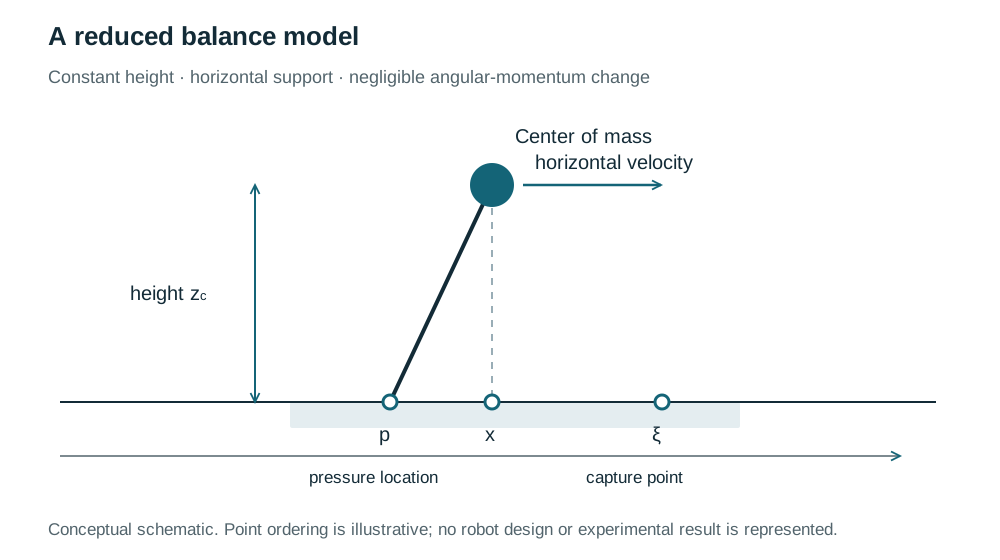
Figure 1 (proposed schematic). A point mass above a horizontal support plane, with distinct center-of-mass position x, pressure location p and capture point ξ. The drawing illustrates Eq. (3)–(5); it is not a robot design or a measured trajectory.
VI. Limitations
The linear inverted-pendulum model restricts height and angular-momentum behavior. It does not establish collision-free joint motion, actuator adequacy, thermal endurance, mechanism strength or recoverability during every disturbance. Physical-consistency checks can reject impossible inertial parameters but cannot establish the true parameter values without suitable evidence. The proposed workflow has not been implemented or shown to cover every failure mode.
VII. Conclusion
Credible humanoid balance research should establish what its body model represents, verify tractable equations against analytical references, and evaluate controllers under explicit conditions. This public-source review supplies a mathematical starting point and a proposed reporting plan. Demonstrating a robot's performance requires a separate experimental contribution with reproducible inputs and measured or simulated outcomes clearly identified.
References
[1] P. M. Wensing, S. Kim and J.-J. Slotine, “Linear Matrix Inequalities for Physically-Consistent Inertial Parameter Identification: A Statistical Perspective on the Mass Distribution,” IEEE Robotics and Automation Letters, 2017. Public author manuscript. DOI: 10.1109/LRA.2017.2729659.
[2] R. Tedrake, “Highly-articulated Legged Robots,” Underactuated Robotics, public course notes. Full text. Accessed 13 September 2026.
[3] J. Pratt, J. Carff, S. Drakunov and A. Goswami, “Capture Point: A Step toward Humanoid Push Recovery,” Proceedings of the IEEE-RAS International Conference on Humanoid Robots, pp. 200–207, 2006. Authors’ institutional publication list. DOI: 10.1109/ICHR.2006.321385. The institutional link is bibliographic, not a promise of unrestricted publisher full-text access.
[4] H. Shi, W. Wang, S. Song and C. K. Liu, “ToddlerBot: Open-Source ML-Compatible Humanoid Platform for Loco-Manipulation,” arXiv:2502.00893, 2025. Public manuscript record. DOI: 10.48550/arXiv.2502.00893.
[5] NASA Glenn Research Center, “Overview of CFD Verification & Validation,” public technical guidance. Full text. Accessed 13 September 2026.
Data and Code Availability
No experimental dataset, robot model or new implementation is released with this review. All sources cited here are public. Equations (5) and (6) are analytical consequences of the declared reduced model; the suggested tests and outcome tables are proposals for a future public study.
Preparation Note
OpenAI Codex assisted with public-source review, drafting, equations and original vector diagrams. This document reports no newly executed hardware or robot experiment. Its structure borrows conventions from IEEE author guidance; no IEEE submission, acceptance, endorsement or peer review is represented.
Have a thought or an experience to share?
Write to us ↗